Halo p Smart. An effective Air purification system To combat viruses, Bacteria And allergens.
Halo p Smart. An effective Air purification system To combat viruses, Bacteria And allergens.
产品类别:空气净化站。ERLAB equips its Halo P air purification stations with a laboratory grade HEPA H14 particulate filter or, if necessary, an ULPA U16 particulate filter for situations ...
广西科米瑞实验仪器设备有限公司提供 Erlab Halo p Smart. An effective Air purification system To combat viruses, Bacteria And allergens. 产品资料、选型咨询、供货报价和售后服务支持,价格面议。
← 返回产品列表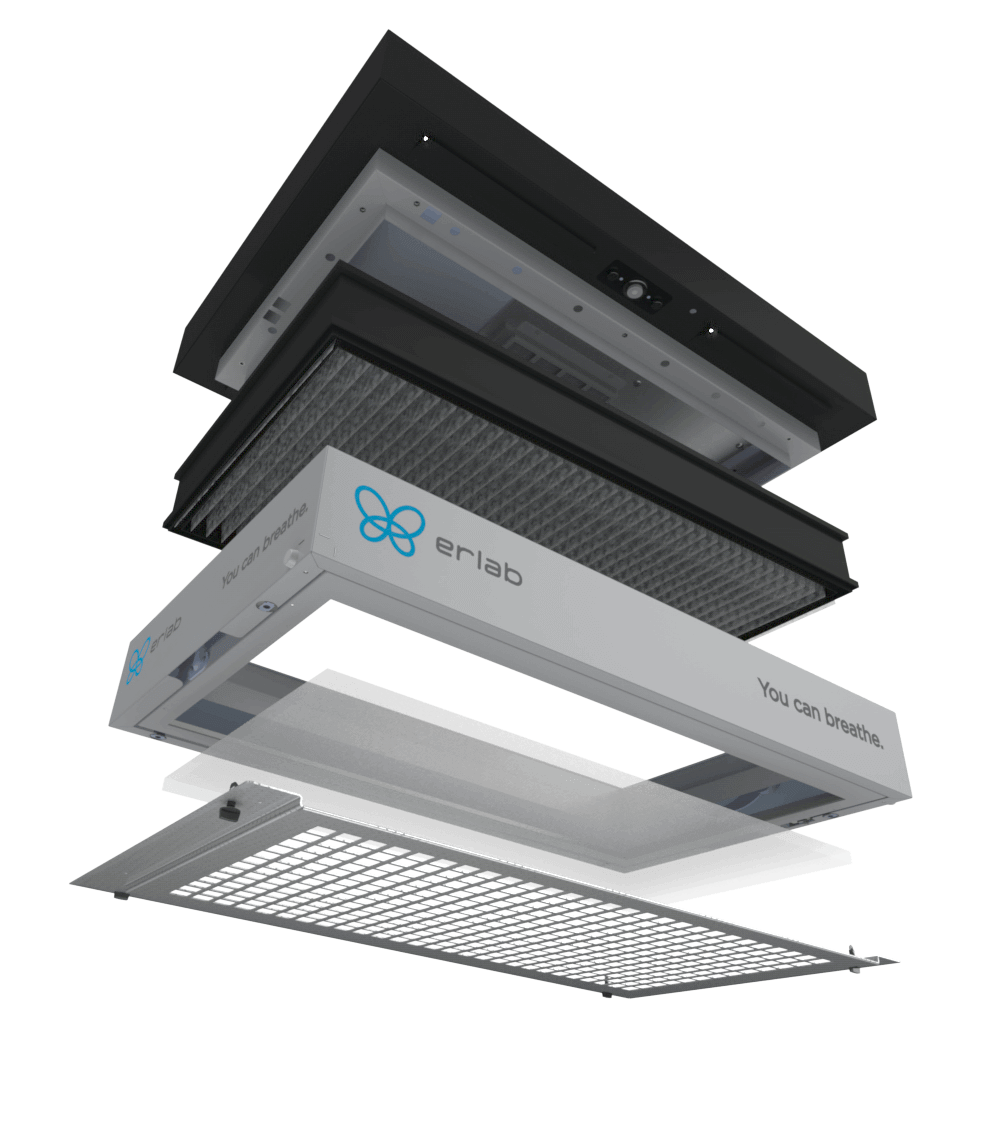
说明
ERLAB equips its Halo P air purification stations with a laboratory grade HEPA H14 particulate filter or, if necessary, an ULPA U16 particulate filter for situations posing the highest health risks.
Compliant with the EN 1822 particulate filtration standard, the HEPA and ULPA filters provided for the Halo P ensure ultra-low particle penetration and can achieve a pollution-free air filtration efficiency of between 99.995% (HEPA H14 filter) and 99.999995% (ULPA U17 filter), which is 10 to 1000 times more powerful than other air filtration systems currently on the market.
These filters are designed for the most complex health situations. They effectively and significantly reduce the spread of all viral and bacterial pollutants, particulate matter and allergens.
They are the same filters as those used in all laboratory microbiological safety cabinets for handling pathogenic microorganisms in total safety.
The ultimate defense against particulate matter (PM 2.5).
Particulate matter, or PM, refers to particles suspended in the atmosphere. It can originate naturally (volcanoes, forest fires, etc.) or due to human activity (diesel, open fires, etc.). A high level of fine or ultrafine particles in the air is a health risk factor which leads to decreased life expectancy. PM is, as a category, classed as carcinogenic for humans by the International Agency for Research on Cancer (IARC), and its inhalation causes or aggravates numerous cardiovascular disorders including myocardial infarction, stroke, and heart failure.
According to the World Health Organization (WHO), PM2.5 (less than 2.5 µm in diameter) kills more than 4,000,000 people per year. Chronic exposure to these particles increases the risk of chronic diseases such as type 2 diabetes and high blood pressure. Children and the elderly are most at risk.
Can all air filtration systems on the market capture the coronavirus
Most air filtration systems on the market lack the necessary power or scale (size, capacity) to guarantee pure, coronavirus-free air in enclosed public places.
Their filters are generally able to capture particles with a diameter of at least 0.3 microns, but they cannot remove coronavirus particles, which are between 0.08 and 0.125 microns in diameter.
FAQ
提交需求
请填写必填信息,我们将在工作日尽快回复。